Tuesday, August 3, 2010

Know Your Enemy: Union

The time has come to move on to those "enemies" who should be far more familiar to Engineer fans... the 11 other teams in the ECAC that comprise the most important 22 games on the schedule. The first team we'll touch on is the one that should stand out even more than the others, if only due to an exceptional amount of familiarity that breeds when you play a team as many times as the Engineers have faced Union in the last few seasons.

Union
Nickname: Dutchmen
Location: Schenectady, NY
Founded: 1790
Conference: ECAC
National Championships: 0
Last NCAA Appearance: 1989 (Division III)
Last Frozen Four: 1985 (Division III)
Coach: Nate Leaman (8th season)
2009-10 Record: 21-12-6 (12-6-4 ECAC, 3rd place)
Series: RPI leads, 44-22-9
First Game: February 26, 1904 (Albany, NY)
Last RPI win: October 30, 2009 (Schenectady, NY)
Last UC win: January 16, 2010 (Schenectady, NY)

2010-11 games: October 30, 2010 (Lake Placid, NY); November 12, 2010 (Schenectady, NY); November 13, 2010 (Troy, NY)
Key players: F Adam Presizniuk, sr.; F Stephane Boileau, sr.; F John Simpson, sr.; F Kelly Zajac, jr.; F Jeremy Welsh, so.; F Wayne Simpson, so.; F Josh Jooris, fr.; D Brock Matheson, sr.; D Greg Coburn, so.; G Keith Kincaid, so.

Key losses: F Mario Valery-Trabucco, F Jason Walters, D Mike Schreiber, D Mike Wakita

Historically, the RPI-Union rivalry was very one sided, albeit in different ways. For decades, the results end of the rivalry was entirely on the side of RPI, while the level of dislike toward the other side was heavily with Union, as the Engineers and their fans historically have focused their most intense feelings on Clarkson.

Both of those facts have been changing over the last five or six years - 11 of Union's 22 all time wins over RPI have come since the beginning of the 2004-05 season. This coincided, in part, with the addition of a non-conference matchup which has seen the Engineers and the Dutchmen face off three times a year (and that ended up being four times last season, when the teams met in the championship of the RPI Tournament). The combination of a suddenly competitive Union squad and the increasing frequency of meeting has certainly injected a considerable amount more drama into the RPI-Union rivalry.

Hockey at Union dates back to 1904 when the team played its first official game, against RPI in Albany, a 4-1 victory for the Engineers. Early on, Union fielded a team only sporadically. They played four games in 1904, then none until 1906, and did not field a team through most of the 1910s. The Dutchmen did outdo RPI in one respect early on in that, like BU, they continually had a team throughout the Great Depression, playing just a handful of games every year through the 20's and 30's. The team was finally suspended due to World War II in 1942, when the Dutchmen lost all eight games they played. They would play 10 more games between 1947 and 1948, but that would be the end of hockey in Schenectady for the next quarter century.

When Ned Harkness returned to the Capital District in 1973, he had three Division I national championships under his belt from his days at RPI and Cornell, and three years of experience coaching and managing in the National Hockey League, and was ready for a new challenge. He became the spark from which the modern era of Union hockey was born, as he built a new program from the ground up, including the construction of Achilles Rink, for which he became the rink manager. Playing in Division III, the team found instant success with one of college hockey's most famous coaches leading the way. The Skating Dutchmen were 45-8-2 under Harkness in their first two-plus seasons with a team that included goaltender Steve Baker, who would go on to play in the NHL, still Union's only NHL alumnus to date.

But just as quickly as Harkness built a winner in Schenectady, it came tumbling down early in the 1977-78 season. Off to a 4-1-1 start, Harkness abruptly quit after a row with Union administration over recruiting. The rest of the team quit along with him, forcing the Dutchmen to dress their JV squad for the remainder of the season - they lost their remaining 13 games.

The Skating Dutchmen would suffer five consecutive losing seasons in the wake of Harkness' departure, but in 1983-84, while their cross-region rivals were starting to reach the heights of success in Division I, the Dutchmen were contenders for the NCAA's first ever Division III championship. That season, Union finished with a winning record for the first time without Harkness since 1940, and advanced all the way to the Division III national championship. That final game was somewhat regrettable, however, as the Babson Beavers thrashed the Dutchmen, 8-0. The following season, Union would make another NCAA tournament appearance, but were stopped short in the semifinals.

Union struggled in the late 80's, but began fielding stronger teams at the very end of the decade once it became known that the Dutchmen would be moving to Division I and joining RPI in the ECAC, replacing Army in the 12-school league. UC's first Division I season was 1991-92, and it was a harbinger of bad times to come. The Dutchmen won only six games in their first two seasons, and failed to reach even 10 wins in seven of their first nine seasons in Division I. They were developing a reputation as a pushover, finishing dead last four times in the 1990s.

That reputation began to fade in part due to the efforts of Kevin Sneddon in the early 2000s, but current coach Nate Leaman - now the longest serving head coach Union's D-I history - spiked it soon upon his arrival in 2003. The team began consistently turning in winning percentages around .500 midway through the decade, finally clearing some major hurdles in the last two seasons, as they won their first ever ECAC playoff series in 2009 to end 18 years of frustration in the post season - which included some classic moments against the Engineers which we don't need to rehash here - and reached the neutral-site championship for the first time last season, making it all the way to the final before losing to Cornell, and narrowly missing out on their first ever NCAA tournament appearance. Coupled with Alaska's first ever NCAA bid last season, the Dutchmen are now the last team playing outside of Atlantic Hockey that has never reached the NCAAs.

The Dutchmen are losing some important offensive components in Valery-Trabucco and Walters - both of whom burned the Engineers repeatedly during their four-year stints in Schenectady - but they still should have the chops to be solidly competitive this season. Presizniuk and Boileau are proven assets, and Zajac had a fantastic sophomore campaign.

Defensively, Union should be strong again despite losing Schreiber and Wakita, especially if Coburn can avoid a sophomore slump. Then, of course, Union returns two solid goaltenders. Keith Kincaid was a deserving Third Team All-ECAC selection in just his first season in Schenectady and should be the go-to-guy between the pipes, but Corey Milan also put up some solid numbers in his time in net, enough to place him in the top 10 nationally in GAA and save percentage even though Kincaid got the lion's share of the minutes.

As far as freshmen are concerned, misery loves company, and while RPI's prize recruit has been pushed off to 2011, so has Union's top commitment. Forward Tyson Fulton, originally scheduled to arrive this fall, will instead spend a year in junior hockey before coming to Schenectady. Jooris, whose father was a key member of the 1985 national championship team at RPI, figures to be a solid offensive contributor, and forward Matt Hatch, who was with Nolan Graham and Johnny Rogic in Alberni Valley last season, will also be a new addition. Among the other new additions is defenseman Mike Ingoldsby, who captained the Oakville Blades to an appearance in the Royal Bank Cup and could replace Schreiber fairly well on the blueline.

For years, it was Union giving RPI a disadvantage while the Engineers were competing for ECAC titles in the 1990s, since the Engineers were not facing teams on Saturday night that had been through a tough game on Friday night. In the mid-2000s, that situation seemed to switch to some degree. Last season, the Capital District travel partners presented a difficult weekend for any team, home or away, and it looks as though that same dynamic might be in play in 2010-11.

The rivalry will be back at full heat over a two-week period as the Dutchmen and Engineers square off in Lake Placid on Halloween Eve, then face off in a home-and-home travel partner weekend in mid-November, the latter half of which will be Black Saturday at home, the change from "Black Friday" being necessitated by the fact that the event is supposed to be the first ECAC home game of the season, and Union will be the only ECAC home game in the first three months of the season.

Saturday, July 31, 2010

Returning to the Stage

In the last couple of weeks, word has come down that Cornell's Riley Nash and Harvard's Louis Leblanc will not be returning to their respective squads. That's a mighty blow to both teams, as both Nash and Leblanc were expected to be offensive leaders for the Ivy League rivals.

That does beg the question - who is coming back? While there's still time for more underclassmen to jump ship (and we, of course, pray that Chicago's emergency minor league roster filling moves does not include calling in Brandon Pirri before he's received enough seasoning in Troy), here's what the outlook is on who should be among the top players in the ECAC, the top 10 returning players (ECAC play only) in each category. No doubt most of these are names you'll be seeing more often than not in the headlines beginning in October... with a few top freshman sprinkled in.

Points
35 - Chase Polacek, Rensselaer
31 - Broc Little, Yale
27 - Adam Estoclet, Dartmouth
27 - Brandon Pirri, Rensselaer
26 - Austin Smith, Colgate
26 - Brian O'Neill, Yale
25 - Harry Zolnierczyk, Brown
24 - Jerry D'Amigo, Rensselaer
24 - Scott Fleming, Dartmouth
23 - Brian Day, Colgate
23 - Jack Maclellan, Brown

Goals
20 - Broc Little, Yale
17 - Chase Polacek, Rensselaer
16 - Scott Fleming, Dartmouth
13 - Brian Day, Colgate
11 - Harry Zolnierczyk, Brown
10 - Francois Brisebois, Colgate
10 - Austin Smith, Colgate
10 - Adam Estoclet, Dartmouth
9 - Mike Kramer, Princeton
9 - Scott Zurevinski, Quinnipiac
9 - Jack Maclellan, Brown
9 - Kelly Zajac, Union

Assists
22 - Brandon Pirri, Rensselaer
19 - Brian O'Neill, Yale
18 - Chase Polacek, Rensselaer
18 - Adam Presizniuk, Union
17 - Jerry D'Amigo, Rensselaer
17 - Adam Estoclet, Dartmouth
17 - Denny Kearney, Yale
16 - Austin Smith, Colgate
16 - Doug Jones, Dartmouth
16 - Andrew Miller, Yale

Power Play Points
15 - Chase Polacek, Rensselaer
15 - Brandon Pirri, Rensselaer
12 - Doug Jones, Dartmouth
11 - Adam Estoclet, Dartmouth
10 - Broc Little, Yale
10 - George Hughes, St. Lawrence
10 - Jeff Buvinow, Brown
10 - Brian O'Neill, Yale
9 - Scott Fleming, Dartmouth
9 - Austin Smith, Colgate
9 - Zach Hansen, Quinnipiac
9 - Adam Presizniuk, Union

Power Play Goals
8 - Scott Fleming, Dartmouth
6 - Chase Polacek, Rensselaer
5 - Brian Day, Colgate
5 - Adam Pawlick, Clarkson
5 - Austin Smith, Colgate
5 - Broc Little, Yale
4 - Marty O'Grady, Rensselaer
4 - Brandon DeFazio, Clarkson
4 - Scott Zurevinski, Quinnipiac
4 - Harry Zolnierczyk, Brown
4 - Nick Prockow, Colgate
4 - Adam Estoclet, Dartmouth
4 - George Hughes, St. Lawrence

Short-Handed Points
5 - Chase Polacek, Rensselaer
2 - Jerry D'Amigo, Rensselaer
2 - Yuri Bouharevich, Quinnipiac
2 - Evan Stephens, Dartmouth
2 - Harry Zolnierczyk, Brown
2 - Jack Maclellan, Brown
2- Corey Tamblyn, Clarkson
2- Scott Fleming, Dartmouth
2- Jacob Drewiske, St. Lawrence

Defenseman Scoring
17 - Jeff Buvinow, Brown
16 - Evan Stephens, Dartmouth
14 - George Hughes, St. Lawrence
13 - Nick D'Agostino, Cornell
13 - Zach Hansen, Quinnipiac
13 - Jimmy Martin, Yale
12 - Taylor Fedun, Princeton
11 - Greg Coburn, Union
11 - Thomas Larkin, Colgate
11 - Chris Huxley, Harvard

Goals Against Average
2.26 - Allen York, Rensselaer
2.46 - Dan Clarke, Quinnipiac
2.54 - Keith Kincaid, Union
2.84 - Ryan Carroll, Harvard
2.95 - Kyle Richter, Harvard
2.95 - James Mello, Dartmouth
2.99 - Nick Maricic, Yale3.23 - Alex Evin, Colgate
3.57 - Paul Karpowich, Clarkson
3.82 - Mike Clemente, Brown

Save Percentage
.919 - Allen York, Rensselaer
.916 - James Mello, Dartmouth
.913 - Kyle Richter, Harvard
.913 - Ryan Carroll, Harvard
.913 - Dan Clarke, Quinnipiac
.910 - Keith Kincaid, Union
.898 - Paul Karpowich, Clarkson
.897 - Alex Evin, Colgate
.889 - Mike Clemente, Brown
.887 - Nick Maricic, Yale

Goals Per Game (Returning)
Yale - 2.81
Dartmouth - 2.68
Rensselaer - 2.59
Colgate - 2.59
Union - 2.00
Brown - 1.90
Harvard - 1.82
Princeton - 1.73
Quinnipiac - 1.73
Clarkson - 1.68
Cornell - 1.68
St. Lawrence - 1.05

-------------------------------------------

While we're at it... a look at the top returning players around the nation.

Points Per Game
1.56 - Gustav Nyquist, Maine
1.51 - Cory Conacher, Canisius
1.42 - James Marcou, UMass
1.33 - Chase Polacek, Rensselaer
1.32 - Stephane Da Costa, Merrimack
1.32 - Brian O'Neill, Yale
1.26 - Cam Atkinson, Boston College
1.23 - Jack Connolly, Minnesota-Duluth
1.22 - Scott Fleming, Dartmouth
1.21 - Broc Little, Yale

Goals Per Game
0.79 - Broc Little, Yale
0.71 - Cam Atkinson, Boston College
0.69 - Scott Fleming, Dartmouth
0.67 - Chase Polacek, Rensselaer
0.62 - Brian Day, Colgate
0.59 - Jacques Lamoureux, Air Force
0.57 - Cory Conacher, Canisius
0.57 - Ian Lowe, Bemidji State
0.56 - Brett Olson, Michigan Tech
0.54 - Justin Fontaine, Minnesota-Duluth

Assists Per Game
1.11 - James Marcou, UMass
1.08 - Gustav Nyquist, Maine
0.94 - Cory Conacher, Canisius
0.85 - Stephane Da Costa, Merrimack
0.85 - Brian O'Neill, Yale
0.85 - Andrew Miller, Yale
0.82 - Andrew Favot, RIT
0.82 - Brandon Pirri, Rensselaer
0.81 - Vincent Scarsella, Canisius
0.81 - Brian Gibbons, Boston College

Power Play Goals
13 - Chase Polacek, Rensselaer
13 - Justin Fontaine, Minnesota-Duluth
13 - Jacques Lamoureux, Air Force
11 - Calle Ridderwall, Notre Dame
11 - Cam Atkinson, Boston College
10 - Scott Fleming, Dartmouth
10 - Tanner House, Maine
10 - Pat Cannone, Miami
9 - Cody Omilusik, Army
9 - Dustin Sather, Alaska
9 - Ian Lowe, Bemidji State
9 - Scott Campbell, UMass-Lowell
9 - Cameron Burt, RIT
9 - Danny Kristo, North Dakota
9 - Tony Mosey, St. Cloud State

Points Per Game (Defensemen)
1.00 - Blake Kessel, New Hampshire
0.89 - Brad Hunt, Bemidji State
0.82 - Erik Gustafsson, Northern Michigan
0.79 - Will O'Neill, Maine
0.79 - Jeff Dimmen, Maine
0.69 - Denny Urban, Robert Morris
0.68 - David Warsofsky, Boston University
0.68 - Jeff Buvinow, Brown
0.68 - Zach Redmond, Ferris State
0.67 - Matthew Irwin, UMass
0.67 - Ben Youds, Minnesota State

Goals Against Average
1.87 - Cody Reichard, Miami
1.97 - Connor Knapp, Miami
2.06 - Corey Milan, Union
2.11 - Brad Eidsness, North Dakota
2.13 - Pat Nagle, Ferris State
2.20 - Scott Greenham, Alaska
2.33 - Bryan Hogan, Michigan
2.33 - Dan Bakala, Bemidji State
2.33 - Scott Gudmandson, Wisconsin
2.36 - Kenny Reiter, Minnesota-Duluth

Save Percentage
.923 - Pat Nagle, Ferris State
.921 - Connor Knapp, Miami
.921 - Cody Reichard, Miami
.919 - Scott Greenham, Alaska
.918 - Ryan Zapolski, Mercyhurst
.917 - Drew Palmisano, Michigan State
.917 - Dan Bakala, Bemidji State
.917 - Corey Milan, Union
.917 - Mike Lee, St. Cloud State
.916 - Dustin Carlson, Ohio State

Tuesday, July 27, 2010

Know Your Enemy: Boston University

Our final non-conference entry in the "Know Your Enemy" series is a school with which the Engineers are intimately familiar with, perhaps the most commonly recurring non-conference opponent that RPI has faced since the Hockey East split in 1984. The casual observer would likely scoff at the idea that a rivalry exists between BU and RPI given the gulf in the achievements of these two programs over the last 25 years, but the all-time series is relatively close and BU-RPI always seems to produce an entertaining contest no matter when or where it happens.

Boston University
Nickname: Terriers
Location: Boston, MA
Founded: 1839
Conference: Hockey East
National Championships: 5 (1971, 1972, 1978, 1995, 2009)
Last NCAA Appearance: 2009
Last Frozen Four: 2009
Coach: Jack Parker (38th season)
2009-10 Record: 18-17-3 (13-12-2 HEA, 3rd place)
Series: BU leads, 33-28-3
First Game: March 14, 1953 (Colorado Springs, CO)
Last RPI win: December 11, 2009 (Boston, MA)
Last BU win: January 2, 2009 (Denver, CO)

2010-11 game: December 11, 2010 (Troy, NY)
Key players: F Chris Connolly, jr.; F Charlie Coyle, fr.; D David Warsofsky, jr.; D Max Nicastro, so.; D Sean Escobedo, so.; G Kieran Millan, jr.

After BU broke from the ECAC as part of the Hockey East split, the Terriers and Engineers did not face each other for six seasons, but since their first non-conference tussle on October 27, 1990 (a 9-7 barnburner in Troy in which the Terriers came out on top) to kick off the 1990-91 season, there have been only two seasons in the intervening 20 years in which there wasn't at least one BU-RPI confrontation. Every year, it's a clash between two programs deep in history at schools in which their positions as the premiere athletic attraction are unrivaled.

BU is one of the few early hockey playing schools which has been able to sponsor hockey relatively uninterrupted. The first season of hockey on Commonwealth Avenue took place in 1918; the program has run continuously with the exception of a two-year lull during the height of World War II since the 1922-23 season. The program's popularity proved able to survive the Great Depression, which a number of other programs (including RPI's) fell victim to in the 1930s, thanks largely to the contributions of coach Wayland Vaughan.

When the Terriers took to the ice after World War II, they did so with a new coach, Harry Cleverly, who would begin the process of etching Boston University as one of the titans of college hockey. Almost immediately upon his arrival in 1945, the Terriers became one of the best teams in the nation, and were instantly among the top contenders, along with hated cross-town rivals Boston College, for the new national championship established in 1948. After BC's national championship win in 1949, Cleverly guided the Terriers to three NCAA tournaments in four years, losing to Colorado College by a lopsided 13-4 score in the 1950 national championship, the closest BU would come to the national title during his tenure.

BU struggled a little bit in the early 1960s, but in the third season under Cleverly's replacement, Jack Kelley, the Terriers started to hit new heights again. Kelley rattled off seven 20-win seasons in eight years from 1965 to 1972 (the Terriers won 19 games in the one "off" year). During that time, BU made four NCAA Tournament appearances, including their first two national championships in 1971 and 1972, which would be the last time any team would win back-to-back national titles until the 2000s, when Minnesota and Denver both accomplished the task in a four year span.

Kelley departed after his second national title in 1972, and he was replaced by RPI head coach Leon Abbott, who did not stay in Boston long. After the Terriers limped to a losing record in 1973, Abbott left BU six games into the 1973-74 season, when a young BU alum would take over as head coach. That alum has been at the helm ever since, and has won more games with a single school than any other coach in the history of college hockey - Jack Parker.

After the Terriers had opened with a 4-2-0 record under Abbott, Parker finished off the season with a 19-6-0 run that ended with an ECAC championship and a Frozen Four appearance. Parker's next four teams would all reach the Frozen Four, with BU's third national title coming in 1978, anchored by names like Mike Eruzione, Jack O'Callahan, and Jim Craig, who would all be instrumental in the Miracle On Ice victory just a few years later.

Another early-decade lull came in the early 1980s, but by the time BU left the ECAC - having claimed six ECAC regular season championships, five ECAC titles, and three national titles during their run in the league - to become a charter member of Hockey East, the Terriers were right back in the thick of things. The 1990s, however, is when BU truly became a titan of the fledgling league. From 1990 to 1997, the Terriers appeared in seven Frozen Fours, missing out only in 1992. The run included three straight 30-win seasons from 1994 to 1996, and a fourth national title in 1995. During the Terriers' dominant '90s, BU picked up five Hockey East regular season titles, four Hockey East tournament titles, and only missed the NCAA Tournament one time, in 1999, and Chris Drury won the team's first Hobey Baker Award in 1998.

That string of success was not as strong in the 2000s, but Parker's teams were still always outstanding. Seven NCAA appearances in the last decade included the school's fifth national championship in 2009, setting a school record with 35 wins as defenseman Matt Gilroy took home the Hobey.

Last year, BU came back to earth despite still having a number of top names from that 2009 championship team. They struggled out of the gate, going 4-9-3 in the first three months of the season, including a 5-3 loss at home to RPI. The Terriers finished strong, going 14-8-0 the rest of the way and managing a 3rd place finish in a crowded Hockey East race, but they crashed out of the playoffs in the semifinals with a loss to Maine.

BU still has juniors and seniors who were part of the 2009 triumph, but their numbers are steadily decreasing. Three key players, Nick Bonino, Colby Cohen, and Kevin Shattenkirk, all gave up eligibility to sign pro contracts during the offseason. Bonino led the Terriers in scoring last year, while defensemen Cohen and Shattenkirk were third and fifth respectively. Additionally, forwards Vinny and Victor Saponari were dismissed from the program, Vinny was fourth on the team in scoring last season.

But there's always something to the BU arsenal. Connelly and Warsofsky are solid scoring threats and the team's top two returning scorers, and blue-chip freshman Charlie Coyle, a first-round selection of the San Jose Sharks, looks to add to that threat. But the challenge is going to be in replacing five of last year's six leading scorers, four of whom had eligibility remaining at the end of last season.

Defense was the bigger problem on Commonwealth Avenue last year. The Terriers had a team GAA of 3.26 last season, ranking them just 42nd in the nation on D. Kieran Millan doesn't have anything to prove to anyone - he did backstop BU to a national championship in his freshman year - but he does need to rebound from a stupefyingly bad season which saw his final save percentage dip below 90%. Unfortunately, the guys in front of Millan seem to be getting younger, not older. Which defense will we see, the one that lost only 6 games en route to a national championship or the one that was torched by Erik Burgdoerfer and Christian Jensen last season?

The Terriers probably aren't high on the list of teams that'll be contending for the Hockey East title, but you can never count them out. Jack Parker, more often than not, manages to wring the very best from his players, and as mentioned, one can never be quite certain what way a BU-RPI contest is going to go. As far as non-conference home games go, the BU game is easily the premier matchup on the Engineers' calendar, and it should produce one heck of a contest no matter what.

Saturday, July 24, 2010

Cop Out

Watch this space in the coming weeks for some guest bloggers - we'll have some insight from around the college hockey world.

But in the meantime - a bit of a filler with no new material (I've been traveling, sue me), but hey! It's an interactive filler! Who says you don't get any input around here? Whoever that was, they were clearly lying through their teeth.


Tuesday, July 20, 2010

Know Your Enemy: Alabama-Huntsville

This week, we look at the last of the three programs invited to the RPI Holiday Tournament - and it's another team down on its luck. While UConn's luck was rough on the ice, and Bowling Green's concerns were a combination of on-ice and off-ice misery, this week's "Know Your Enemy" completes the circle with a program who's going through mainly off-ice turmoil.

Alabama-Huntsville
Nickname: Chargers
Location: Huntsville, AL
Founded: 1969
Conference: Independent
National Championships: 2 (Division II in 1996 and 1998)
Last NCAA Appearance: 2010
Last Frozen Four: 1998 (Division II)
Coach: Chris Luongo (1st season)
2009-10 Record: 12-18-3 (6-10-2 CHA, 3rd place)
Series: RPI leads, 3-0-1
First Game: November 30, 1991 (Huntsville, AL)
Last RPI win: January 15, 1993 (Troy, NY)
Last UAH win: Never

2010-11 games: November 27, 2010 (Troy, NY - potential), December 30-31, 2010 (Huntsville, AL)
Key players: F Neil Ruffini, sr.; F Cody Campbell, jr.; F Alex Allan, fr.; F Lasse Uusivirta, fr.; D Curtis deBruyn, so.

The Chargers, long a quirk of the college hockey world as the only program in the Deep South, embark on their first season in over a decade as an independent program this year. What does that mean? Well, teams that are part of a conference have a much easier time with scheduling. When Seth Appert sits down to work out schedules for the future, he's already got a significant chunk of it done with before he even starts - the ECAC schedule is 22 games long, and every league weekend other than the travel partner games are predetermined by the league. For independents, they don't have that luxury. They need to find enough teams willing to play them as part of their non-conference schedule to fill out an entire season.

To their credit, they've got 32 games on their schedule, which is just about a full schedule, but most teams willing to play UAH required them to hit the road - the Chargers have only 8 contests on their schedule on their home ice at the Von Braun Center in Huntsville. Four other home games will take place in Birmingham or Nashville, TN.

RPI, however, may have done more than any other team to help UAH fill out their schedule. Not only did they extend an invitation to the RPI Tournament in November, the Engineers will travel to Huntsville for games on the last two days of 2010, helping them fill 4 full games on their schedule.

Hockey isn't just some fleeting fad in Huntsville - their hockey pedigree dates back to 1979, when the Chargers began what would quickly become a wildly successful club team. The first iteration of UAH hockey finished with a 21-1-0 record in 1980, and the Chargers quickly became the dominant force in club hockey, especially once Doug Ross took the reins in 1982, earning three straight national championships between 1982 and 1984, and just missing out on four straight national crowns after losing to North Dakota State in the championship in 1985.

The next season, UAH's athletic department joined the NCAA, and with that came varsity hockey for the first time. The Chargers' first season in the NCAA was in 1986-87, when they finished with an impressive 20-10-0 record in Division II, as famed Alabama governor George Wallace named Huntsville "The Hockey Capital of the South."

UAH's first stint as a Division I independent came in just their second season in the NCAA, as the Division II championship had been abolished in 1985. The Chargers spent five seasons in Division I, struggling to a 63-81-9 record in that span.

In 1992, the NCAA reinstated the Division II championship, and the Chargers returned to that level, where they would build one of the strangest rivalries in college sports while experiencing the true heyday of their program. Between 1993 and 1998, the Bemidji State Beavers from tiny Bemidji, MN played in the Division II national championship game every single season - but more often than not, so were the Chargers, who missed only two of those contests during the same time period. The pure domination of the two schools from very different parts of the country gave birth to a rivalry between them that lasts to this day.

Ross' teams put up a record of 125-33-10 during those years in Division II, including an unbeaten record of 26-0-3 in 1996 on their way to their first ever national championship. They would claim a second one in 1998 after falling to Bemidji State a year prior. That would be the last hurrah in Division II for both UAH and BSU, as the NCAA announced its intent to abolish the Division II championship again after the 1998-99 season, and both teams returned to Division I as the core of a new conference: College Hockey America.

After transitional season as an independent - which saw the Chargers play a largely D-II schedule - the CHA got underway in time for the 1999-2000 season, and UAH was immediately among the best teams in the conference. They won 21 games in 2001, eclipsing the 20-win mark for the first time as a full Division I program on their way to the CHA regular season title. They would win a second regular season crown in 2003, but the tournament title - and thus, an NCAA bid - eluded them. The Chargers put up their last winning season to date in 2006.

In 2007, Doug Ross, the only coach the school had known for its 22 varsity seasons, announced he would be leaving the program in the middle of what was already a rough season. But the team turned it on when it counted, in the CHA playoffs. Despite coming in last place in the 5-team league during the regular season, the Chargers made an astounding run through the playoffs, claiming the CHA title for a fairytale ending to Ross' career, becoming the first team in the history of Division I hockey to finish last in their conference but earn an NCAA bid. Matched with juggernaut Notre Dame, few gave the Chargers a chance, but UAH would ultimately take the Irish to a second overtime before bowing out.

Michigan State alum Danton Cole took over for Ross as the Chargers' future started to get a little murky. Air Force's defection to Atlantic Hockey in 2006 had left the CHA with five teams, one short of what it needed to maintain its automatic bid to the NCAA Tournament. In the midst of Ross' last season, Wayne State announced it would fold its program at the end of the season, leaving the CHA with just four teams, and it became obvious that each team would need to look elsewhere and find another conference for the sake of their programs. Cole's first two teams failed to crack 10 wins, but the team rebounded last season to finish third in the CHA, earning wins over Robert Morris and Niagara to claim the final CHA championship and a 2nd trip to the NCAA Tournament despite losing records ahead of both trips.

Prior to last season, the chips began to fall into place for the other teams in the CHA, as Bemidji State gained acceptance into the WCHA, while Niagara and Robert Morris announced that they would join Atlantic Hockey. Alabama-Huntsville, owing to its geographic location, applied to join the CCHA, and their hopes were increased somewhat by the news that the CCHA's Nebraska-Omaha would join Bemidji State in the WCHA - UAH would thus become the CCHA's 12th team. Unfortunately, word came down that the Chargers' application to join the league had been rejected: the CCHA would soldier on with 11 teams rather than take on the Chargers, leaving UAH no choice but to rejoin the Division I independent ranks for a third time. They are now the only independent program in Division I, and continue to seek a permanent home. Without one, the long-term viability of the program will be in serious jeopardy.

Additionally, Cole announced last month that he would leave UAH for a position with USA Hockey. His position was quickly filled with assistant coach Chris Luongo, which will likely soften the blow of losing one of the key pieces holding a fragile program together.

UAH is probably the best team in the RPI Tournament field outside of the Engineers - but as we've already seen, that's not terribly difficult to accomplish. The Chargers had scoring issues of their own last year, netting only 2.21 goals per game, which was good for only 52nd out of 58 teams in the nation, but better by a good sight than UConn or Bowling Green. Their defense was much better, finishing with a team GAA of 2.70, but that might be a bit dicey coming into the new season.

The Chargers have one goaltender returning from the 2009-10 campaign, losing starting goaltender Cameron Talbot to the New York Rangers with a year of eligibility to go - thanks largely to an impressive showing against Miami in the NCAA tournament - and losing little-used backup Blake MacNicol to graduation. They have two freshmen coming in to replace them, C.J. Groh and Clarke Saunders. The one returning goalie, Johnny Griggs, didn't see any ice time last season. At this point, it's too early to tell which one will get the nod as the go-to guy, but considering the number of times the Engineers may see the Chargers, we'll probably see more than one, or even all three. Additionally, they graduated three starting defensemen last season - so defensively, it's hard to know what to expect. It probably won't be as good as it was last year.

The good news for Huntsville is that they return four of their top six scorers from last season. None breached 10 goals last season, but all will be another year older and another year wiser, so expect UAH to be at least somewhat competent with the puck.

As mentioned last week, it's probably preferable simply from a variety standpoint to avoid UAH in the RPI tournament if at all possible, but given the quality of the teams each one faces in the first round, they are likely favorites to meet in the championship. The two games in Huntsville beckon a month later - and if you're a fan of college hockey in general as well as an RPI fan, you owe it to yourself to consider taking a trip to spend New Year's in Alabama, because you'll be hard-pressed to find a more unique college hockey locale.

Friday, July 16, 2010

Renovate This

This week, I was fortunate to have the opportunity to take a guided tour of the Houston Field House, which is in the middle of its renovation process. The place is a mess, but it's a construction site - and given that I grew up on construction sites, I'm used to them being a mess. Parts of the interior are certainly easily identifiable, but other parts are very different now... as you'll see shortly.

Hat tip to John Crawford for the pictures.


The exterior. As you can see, the reintroduction of the exterior windows is well underway...

...but not yet finished. The right side of the wall still needs to be torn out.


The circle in front of the Field House is looking drastically different as well, since all of the trees within it have been taken down. This will allow for a majestic view of the Field House as one progresses east up Peoples Avenue in the winter time.


Here's a view of the South Side (looking east), looking about as loud and lively as it is on a typical game night.


Facing the eastern wall and the North Side. As you can see, the eastern curtain is gone, making the building seem a lot more like the warehouse that it originally was. The other glaring omission is the center scoreboard - it is indeed gone. If it had been staying, it probably would have been lowered for the painting of the rafters (our guide mentioned that they found some 30-40 pucks sitting on the I-beams in the ceiling, players like to throw them up there to see if they can get them stuck during practice), then covered and raised to the top for construction. As it is, unless it's been completely disassembled and hidden, it's no longer on the premises.

All of the ECAC team banners and Rensselaer banners in the rafters are gone, as are, naturally, the championship banners and Ring of Honor banners that were hanging on the western wall (along with the giant RPI seal) since that wall is now going to have windows to the outside. As far as I know, they haven't made a decision on exactly where those banners are going, but given their size I suspect they are going to have to make some newer, possibly smaller ones to be hung in the rafters.

The catwalks are staying in place, and they have also been repainted. The lighting situation is also set to be improved, although it appears they will still use metal halide lamps, the new paint and new lights will hopefully make the interior considerably brighter. Hopefully, they got the Lighting Research Center involved in perfecting the situation.


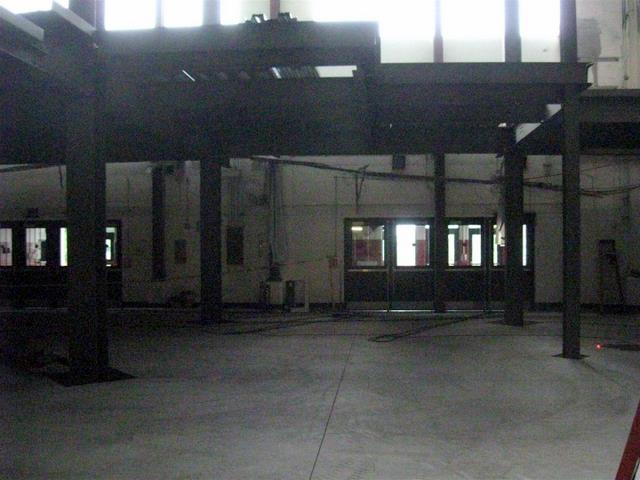
It was much more difficult to get a good picture of the new structure being built in the former location of Section 1, thanks to the present lighting situation in the Field House, which makes most of the building dark with the exception of the natural sunlight that the open western wall is providing, but this is underneath said structure looking toward the front doors that lead into the lobby (which we didn't get a look at). The "Alumni in the NHL" and "All-Americans" display has been removed - sadly, it was never updated after it was first installed in the early 2000s, but I'm told it will be replaced with an even more majestic display.

As to the structure itself, it will house the Field House's new luxury suites and will absolutely be a defining feature of the new layout.


This is a better picture of what the structure looks like, but as you can see the lighting difference from the interior to the natural light made it really difficult to get a decent shot - this is probably the best look at it.


Here's another one.


Behind the Field House, lots of odds and ends. Both zambonis and the forklift, which are typically parked inside, must now sit outside. The various staging (including the band's stage) and stairways used during concerts are now also sitting outside since their storage space is currently being occupied. Some of the dashers are also being stored out here.

All in all, it's obvious that work is well underway on the renovations, and it certainly looks like the Field House is going to look better than it has in ages. They're hoping to have everything taken care of by the end of August, and I guarantee we'll have some pictures of the finished product on or before September 1st as long as they meet their deadline.

Tuesday, July 13, 2010

Know Your Enemy: Bowling Green

Last week we touched on a team in Atlantic Hockey that was limping along in their recent history. Today, in part seven of "Know Your Enemy," we discuss a program that has perhaps the most striking night and day history you'll ever see, a program that has reached the highest of the highs but has descended to the lowest of lows. They're also the only one in our series who the Engineers may not actually see this season - the only "potential" enemy on the schedule.

Bowling Green
Nickname: Falcons
Location: Bowling Green, OH
Founded: 1910
Conference: CCHA
National Championships: 1 (1984)
Last NCAA Appearance: 1990
Last Frozen Four: 1984
Coach: Chris Bergeron (1st season)
2009-10 Record: 5-25-6 (4-18-6-5 CCHA, 11th place)
Series: Tied, 8-8-1
First Game: January 2, 1970 (Troy, NY)
Last RPI win: January 18, 2002 (Troy, NY)
Last BGSU win: January 20, 2001 (Bowling Green, OH)

2010-11 game: November 27, 2010 (Troy, NY - potential)
Key players: F David Solway, sr.; F Jordan Samuels-Thomas, so.; F Bryce Williamson, fr.; F Andrew Wallace, fr.; D Andrew Krelove, sr.; G Nick Eno, sr.

One of only a handful of former national champions with only one to their name - Harvard and Northern Michigan are the only other ones - Bowling Green State University was a beast during the 1980s, but are now in one of the toughest positions in all of college hockey: threatened with the loss of their program. No former national champion has ever later gone on to drop hockey altogether, and though much of the immediate danger of this actually happening has passed, the program is still dealing with some of the fallout of the news last year that hockey may have been on the chopping block.

Varsity hockey at BGSU began in 1969, when the Falcons played their first two seasons in Division III's MCHA before becoming a charter member of the CCHA in 1971. Bowling Green was immediately one of the best teams in the new conference, finishing third in its first season and winning the league title in 1973. The following season, Ron Mason would come to BGSU from Lake Superior State, where he had guided the Lakers to an amazing record of 129-47-8 record over seven seasons. Mason became known at LSSU, he would begin to build what would become his legendary status at BGSU.

The Falcons remained CCHA contenders early in Mason's tenure, but he would take them even higher. They would finish first in the regular season for the first time in 1976, and won the first of three straight CCHA championships in 1977, reaching the Frozen Four for the first time in 1978, just nine seasons into their varsity hockey existence. Mason left in 1979 for Michigan State having secured six 20-win seasons in as many tries, and guiding the Falcons to back-to-back 30-win seasons in 1978 and 1979, a very impressive feat for that day and age.

Mason had been a legend in the making, and he was replaced by yet another legend in the making - Jerry York. York had been coaching at Clarkson for seven seasons when the BGSU job became available, and it was under York that the Falcons would reach their greatest heights. The team claimed the storied MacNaughton Cup in each of the only three years it was awarded in the CCHA (Michigan Tech, the award's trustee, left the WCHA for the CCHA from 1981 to 1984) as the regular season champions, and in 1984, BGSU rose to the very top of the college hockey world, knocking off BU and their old coach Ron Mason's Michigan State before playing the longest national championship game in the history of the Frozen Four - a 4 overtime thriller in Lake Placid that ended when BGSU's Gino Cavallini netted the game winner against Minnesota-Duluth to claim the title.

York would guide BGSU to another CCHA regular season title in 1987, a CCHA championship in 1988, and four straight NCAA appearances from 1987 to 1990, but the Falcons would not reach those heights again. They were one-and-done in each of their NCAA appearances, and despite York's 9 straight 20-win seasons from 1981 to 1990, the party was definitely over in Bowling Green. The Falcons would limp through four losing seasons in York's final four seasons, and he left for his alma mater, Boston College, in 1994 - like Mason, leaving BGSU for a job which would make him even more legendary. Mason and York are now 1-2 in most wins by a coach in college hockey.

Buddy Powers, who was, at the time, behind the bench in Troy, was BGSU's choice to replace York in 1994. Powers had taken the Engineers to the NCAA Tournament for the first time since their national championship in 1985 and had built the core of the team that would claim the ECAC title in 1995. Powers showed promise in his first two seasons, guiding the Falcons to back-to-back 20-win seasons and a 2nd place regular season showing in 1995, but things would drop off fairly quickly. The Falcons finished 11th in the CCHA in 1998, failing to reach 10 wins for the first time in school history. Powers would be at the helm for four more losing seasons before leaving the school in 2002.

Since 1997, Powers' third season in Bowling Green, the Falcons have finished with a record at .500 only once, in 2005, and have never finished above .500. Over the past nine seasons, BGSU has finished either last or next to last in the CCHA six times, and has amassed a CCHA playoff record of 2-19 during that stretch.

Things got worse in 2009. A budget shortfall at the school led to the scrapping of a planned renovation on BGSU's rink. Shortly thereafter, word came down that the program itself might have become the next victim. Some players, concerned about the future of the program, chose to transfer - including Nick Bailen, who played for the Falcons in the 2008-09 season and will be a sophomore at RPI this season. Head coach Scott Paluch then left the program to take a position at USA Hockey. Things looked grim, and in 2010, under interim coach Dennis Williams, BGSU won only 5 games all season, by far their lowest total in program history.

Chris Bergeron, a long-time assistant at Miami, now has the task of righting the ship in Bowling Green, and it will not be easy. Although alumni funding and fundraising has helped raise the money needed to keep the program going, Bergeron will need to start bringing in the kinds of talent that have been missing at BGSU for nearly 20 years to get this program on its feet again. In the meantime, however, there's a big hole for the Falcons to climb out of. Remember last week when we mentioned that only one team besides UConn scored at a clip below 2.00 goals per game? Bowling Green was that other team, managing a pace of only 1.97. Their defense was even worse than that of the Huskies, as the Falcons had a team GAA of 3.83, though that can at least be partially explained by the fact that BGSU plays in a more difficult conference. The Falcons were fourth in the nation in penalty minutes per game, and dead last in penalty killing, snuffing out less than 3 in 4 of their opponent's power plays. Their own power plays were equally dreadful, scoring on only 11.7% of their man advantages, 56th in the nation out of 58. In short, nothing worked last year for BGSU.

There's not really anywhere else to go but up for the Falcons, but it does get worse. Six of their eight highest scorers - on a team with very little scoring - were seniors. Samuels-Thomas did lead the team in scoring last year with 11 goals and 14 assists, while Solway was third with 5 goals and 13 assists, but it's difficult to see where else the scoring might be coming from. There's probably going to need to be a huge contribution from the freshmen (along the line of Samuels-Thomas' freshman campaign last year), especially Williamson and Wallace, if things are going to improve.

Defensively, senior goaltender Nick Eno is a Buffalo draftee, but Eno has never put up numbers like he had in his freshman year, which weren't much to write home about: 2.79 GAA and .905 save percentage. Unless freshman Wyatt Galley is ready to step in and be the man in Bowling Green, things don't look promising in net, either.

Most RPI fans will probably be hoping for a matchup with BGSU, if only because it would mean avoiding a matchup with Alabama-Huntsville, who the Engineers have two confirmed games against the following month. The strategy for dealing with the Falcons would be remarkably similar to the strategy for the Huskies - the ability to get up for this game would be key with the student section empty for the tournament. Unless BGSU's freshmen turn out to be some kind of super class, this is also a game RPI would have to win decisively if they are going to be vying for bigger and better things down the road.